10. The Mills
Water and Wind Power
Water Mills were first built in the period beginning 700 AD, in Saxon times. The Harley Mill which is now a stone built house, is located at the bottom of what is now appropriately called Mill Bank. The original construction would have been in timber, with a thatched roof. This one had a very long leat as shown on the 1842 Tithe Map.
Leats are artificial, water channels, hand dug to divert water from the river, to drive the water wheel. It is also clearly shown on present day Ordnance Survey maps. The wheel, made of timber, was almost certainly an overshot wheel. The level of the starting point of the leat back upstream had to be higher than the top of the wheel in order to achieve a proper flow, hence the long leat. The Harley Mill remained in use, grinding corn to produce flour until 1905, until the advent of non-local milling.
The Shrewsbury Museum has a glass lantern slide dated 1948 which shows the interior with the original mill mechanisms. These have been retained in the present house. But the house has been uninhabitable in recent years due to repeated flooding.


In the 17th and the 18th centuries there were two water mills in operation and were held by the Carter family from 1619 to 1734. One was obviously the one located at the bottom of Mill bank but it is not known where the other was. It seems that it could not have been located on Harley Brook, which used to be a river. This watercourse does have tributaries so the second mill must have been located on one of these. Maybe over the years the flow diminished to such an extent that it was closed. Being constructed of timber and thatch it is understandable that the structure has disappeared without trace
Domesday documents show some 1524 Water Mills in England. They are the earliest form of non-human or non-animal power.
On the subject of milling, there was another mill in Harley; the Windmill. This is not recorded in Domesday as the earliest recorded windmill was in East Yorkshire in 1185.
The Harley Windmill was located to the north of the village, on relatively higher ground. It is said that it was demolished in 1960 to make way for a pair of houses which incorporated part of the old windmill building now combined as Harley Court. However the Shrewsbury Museum has a glass lantern slide of the Windmill with a note that it was demolished in 1929.
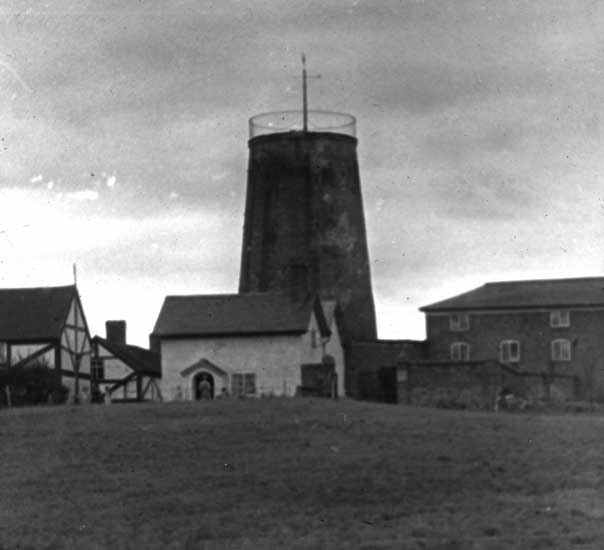
The first windmills date from medieval times, from the mid to late 12th century. These were generally of poor construction. Later ones dating from the 16th century were called Tower Mills and were more robustly built of stone and brick. It may be, because the word Tower is used in the names of three of the present houses nearby, that this Windmill was one of the latter.