6. The Iron Age
The only entry in the Archaeological Record for Harley in the Iron Age is a large ditched rectangular cropmark near to the present day Nursery on the edge of the village, with another earlier enclosure on the east side. This is probably of late Iron Age to Roman date. There is no indication as to what this was or what its use was.
It is disappointing that this is the only evidence that exists in the Harley area, as there was, by the late Iron Age, according to Trevor Rowley a fairly large population inhabiting the landscape of lowland Britain, which was covered with hamlets villages and farmsteads divided up into estates. There is no reason to believe that the Harley area was different.
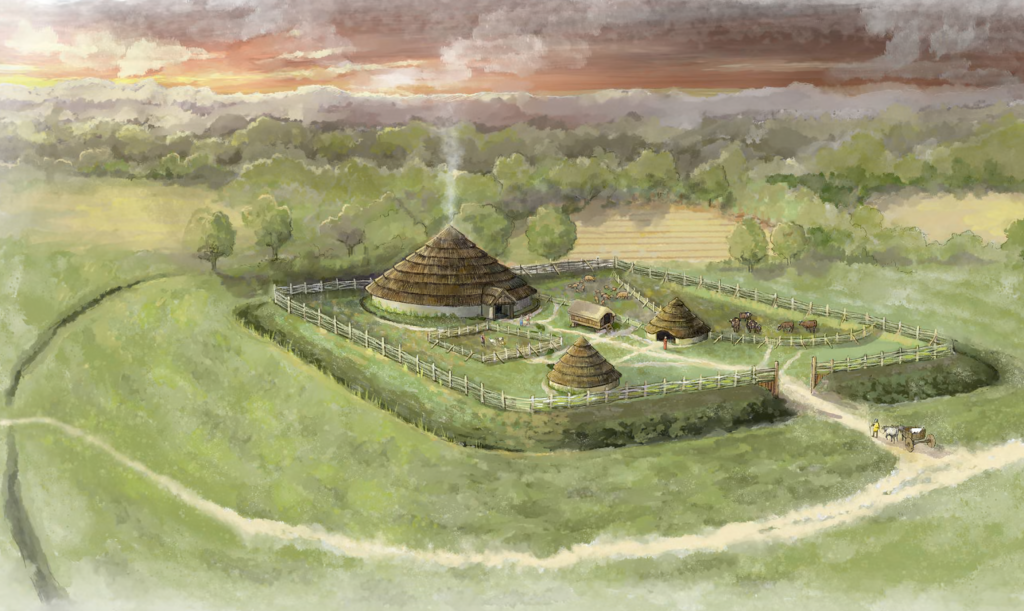
The lowland areas of the Severn valley would have been scattered with farmsteads. Aerial photographs taken in the 1930s have confirmed this. Each farmstead would have would have consisted of a small group of buildings protected by banks and ditches with a wooden palisade or fence. Each would have been home to one extended family who would have been largely self-sufficient. They grew wheat and barley and oats. These people did not use much pottery or money but made items themselves out of wood or leather.
The Celtic people in this part of Shropshire in the 1st century were known as the Cornovii. It is thought that their headquarters was the hill top fort on top of the Wrekin. This prominent hill top is visible from Harley. The well defended hill top could have housed up to 1000 people and local people may have gone there in times of danger, but it is not certain that they lived there all the time.

Harley village would have been under the rule of the Cornovii. The villagers, the farmers, would have paid tribute in the form of grain to the local Chieftain.
The Romans said the Celts were vain. They attended to their appearance and personal hygiene, wore gold and bronze Torcs (necklaces). They were expert weavers and dyers and loved bright colours. The women wore their hair in two thick plaits, thigh length. However no fine pottery or metal artifacts have been found. Despite being meat eaters, it was a pastoral economy, reliant on the local farming community once again. However, Archeologist Lloyd Laing wrote that they drank milk, ate meat and wore skins.
There is no indication or record of Druid activity in Harley or in the local area.