33. Harley in Wartime
The Mock Airfield (The bombing decoy)
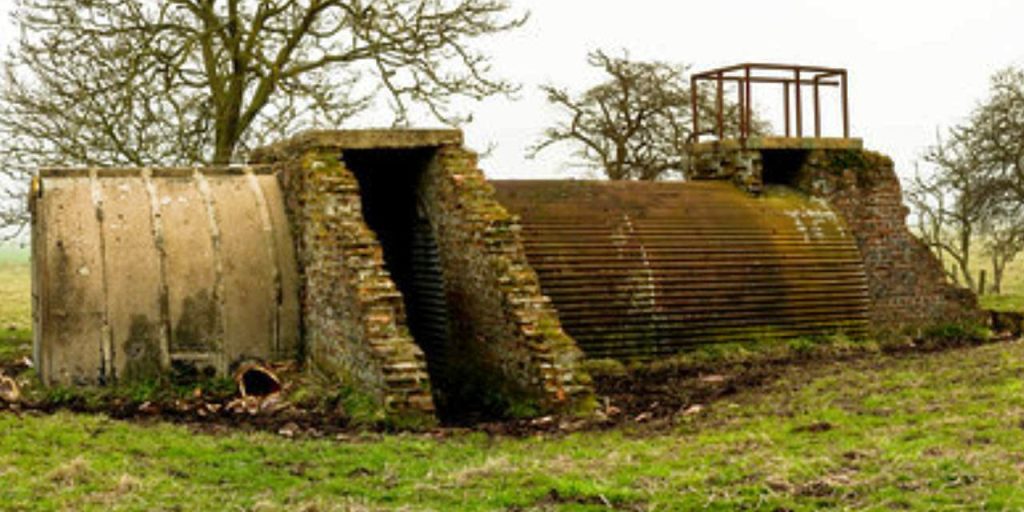
During the Second World War, the War Department built a small brick building in a field on rising ground off the Kenley Road towards the Crow’s Nest.
The building still exists and originally housed a generator, two long lengths of cables and lights and also a searchlight control.
Tom Cole, the Policeman potter, who then lived at Windmill Cottage reported the existence of the building and its contents to Shropshire Council. The Archaeological Department recorded the building on 21 July 1978 as a World War Two Defence Structure.
The parallel rows of lights were intended to appear from the air as an airfield, to act presumably as a decoy for the Luftwaffe. No information exists that any bombs were dropped, so things must have remained very quiet on the Harley front.
Liverpool refugees
Two young teenage girls from Liverpool were sent as refugees to Harley during the war. They stayed at Rowley Farm, but only for about a week, apparently country life was not for them.
In September 1999, one of the girls, Betty Blake, revisited Harley with friends and family. At the door of Rowley Farm she had the shock of her life. She saw a little girl who looked just like the girl she remembered in the war and who looked to be about the same age.
A postscript to this is contained in the writings of Phyllis Munslow, wife of Hector Munslow, who farmed Rowley Farm earlier.
During the war we had evacuees in Harley. There were about twenty of them but more than half of them didn’t stay. You picked the ones you wanted. My mother took in two girls and our neighbours took in another two. They were four sisters and we thought if they lived next door they could play together. They came from Liverpool but they didn’t stay long – only a week. They weren’t happy; it wasn’t their sort of life. They wanted chips, chips, chips. One other girl stayed on at the Red House up the hill (Harley Bank) and has stayed all her life.
Phyllis Munslow
Not too long ago one of them came back to see me. I used to play cricket with them in the paddock and she hadn’t forgotten. It wasn’t too long ago that she came – she would have been in her forties or fifties then (Betty Blake was in fact 71).
Phyllis probably wrote this shortly before she died in her nineties and she must have been in the house when Betty called.
The full version of this story is contained in Village Tales; a separate section following The Harley Story.
Kelly’s Directory 1941
This short summary gives a fascinating glimpse of war time Harley seemingly relatively unaffected by world events.

The heading Private Residents does refer to a fuller list of residents elsewhere, but does mention two, The Rev. Horace Dangerfield, Miss Horton of Harley Tower.
Under the heading Commercial is a list of tradespeople and farmers which draws a vivid picture of Harley at this fairly recent time.
Farmers with over 150 acres:
Leonard Brookshaw – Harley Farm Cressage, 25 acres and Forge Farm/ Harry Gregory – Blakeway / Percy Marston – Rowley / Alfred Munslow, Harley House Farm / Walter Munslow – Mill Farm / William Robinson – Farmer
Others were listed as Maurice Bedford – Blacksmith, Nellie Brazier – Smallholder, Jas Jarrett – Cowkeeper, Arthur E Jones – Inn keeper of Plume of Feathers, William Frederick Preece – Post Office.