19. The Luttrell Psalter
The Luttrell Psalter is an illuminated psalter commissioned by Sir Geoffrey Luttrell (1275 – 1345) who was Lord of the Manor of Irnham in Lincolnshire. It was written and illustrated on parchment c1320 – 1340 in England by anonymous scribes and artists.
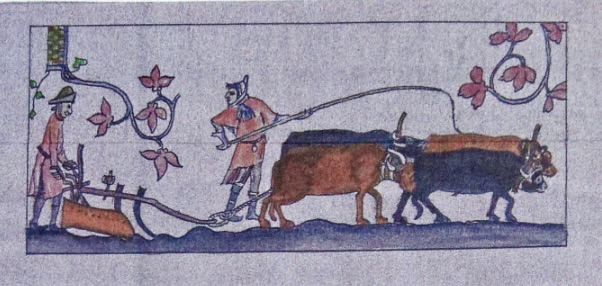
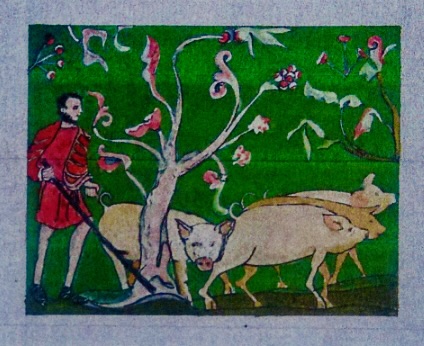
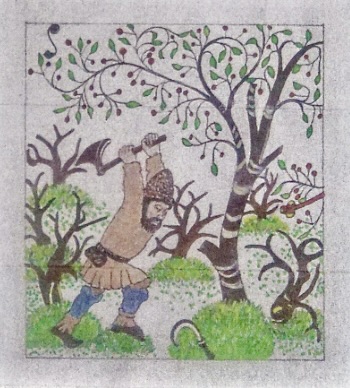
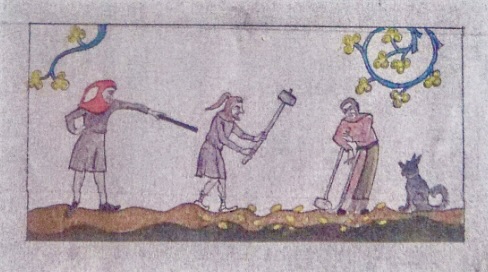
It is considered to be one of the richest sources of visual depictions of everyday rural life in medieval England.
Sir Geoffrey requested 20 chaplains to recite masses for a five year period after his death (this was believed to speed up the soul’s passage through purgatory) and clerks to recite the Psalms.
The Luttrell Psalter was composed by many artists each with a different style. Four were named. These were The Decorator, The Colourist, The Illustrator and the Luttrell Master who was skilled in rural themes and outlandish grotesques.
Bear in mind that there is a 19th Century Victorian romantic vision of ‘Merrie England’ peopled by bountiful Lords and Ladies with happy peasants playing hard as they worked. The Psalter scenes are idealized versions of reality. They were, after all, designed to please Sir Geoffrey not the workers who probably never saw them.
Compared to the Villagers the Lords and their families were well fed, well clothed and shod. They were wealthy, lived in palatial Manor Houses and had a good life. For the lower classes life was brutal and often very short. Their living conditions were squalid and they were often confined to one room. Work was very hard and unrelenting. Their diet was basic and if the harvest was poor due to bad weather they starved to death.
The drawings are reduced size drawings forming part of a collection done for the Much Wenlock Museum by myself, Allan Howard and are redrawn from the Psalter drawings. Some have been slightly altered, with apologies to the original artists.
The relatively short period from 1301 to 1349 was a kind of peak time in the fortunes of Harley Village. The Village had a new stone built Norman church and a resident Lord and Lady of the Manor.
Economically, the first half of the 14th Century was relatively high and villages like Harley across England prospered.
But the good times were not to last.