Son Brazier and his mother Martha
By the year 2000 Son was the oldest resident of Harley. When he was born, the midwife, so the story goes, exclaimed to Martha, his mother, ‘ Oh, it’s a son.’ The name Son stuck, and even though his real name was Albert, he was called Son or Sonny all his life by everyone.
Son and his family lived at No 3 Harley, by the Church. His mother Martha had her fifteen minutes of fame when Journalist Phil Llewellin of the Shrewsbury Chronicle wrote about the effects of the new bypass had had on the village. Martha at 88 said she thought the bypass had made the village too quiet!
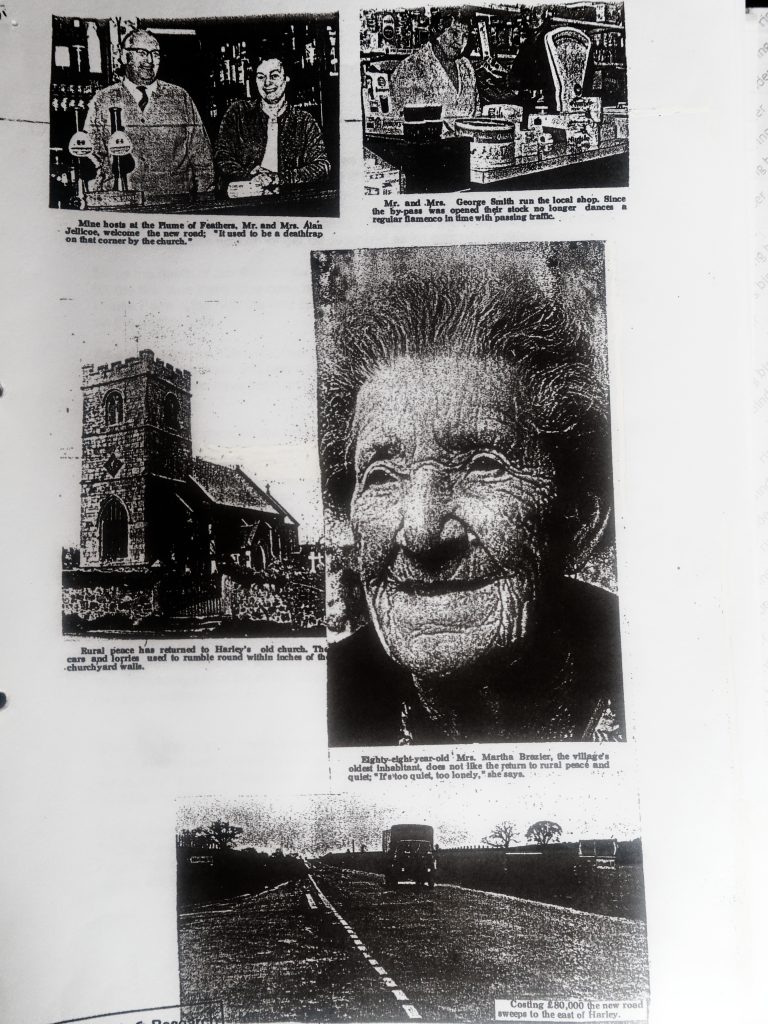
The article is dated 12 May, 1967 and here, despite the journalistic gymnastics is the article almost verbatim.
A return to the past for the village of Harley
For the past 60 years – like a giant wrestler slowly but surely increasing the power of his grip – the combined blessing and bane of the internal combustion engine has been strangling the pretty village of Harley.
Anyone who has driven on the A458 from Shrewsbury to Bridgnorth will be only too aware of the condition known as the Harley Horrors. The symptoms:- an acute tensing of nerves, a sharpening of reflexes, an uneasy feeling that this spot stands a good chance of being where IT happens.
And the cure, nothing more elaborate than going very slowly and praying, with right foot quivering in readiness to hit the brake and with hands gripping the wheel ready to take dramatic avoiding action.
For Harley’s life began in days long lost in the mists of time and the village grew up when traffic meant lumbering packhorses and plodding pilgrims, men in armour clanking magnificently to war, in an age when wild boar roamed a thickly wooded land and London was as distant as the far planets.
The road was the community’s lifeline and newspaper. Along it came, weeks, months later, news of victories and defeats, births and deaths, coronations and calamities.
Then came the motor car, a novelty at first, a thing to be stared at, something to frighten children and the aged. And before long the lifeline had become a source of potential death and very real annoyance.
The mellowed houses in weathered brick or timber and thatch, crowd into the narrow canyon of road as it swings round a sharp blind bend by the ancient church. With Wenlock Edge and its lovely trees as a backdrop the smells and sounds of the countryside walk with the visitor. Did Housman write about Harley? He should have done.
Until recently, my one aim was to get through Harley in one piece, and as quickly as possible combining speed with caution. But the life of the village has been changed suddenly and dramatically.
A new road, the Harley by-pass now cuts a broad bold swathe through the rich green land to the east, running arrow-straight towards the Edge and between the village and its delightfully named neighbours Wig Wig and Homer.
In Harley today the traffic is already becoming a memory kept alive by the distant hum of cars and lorries pounding about their business.
The Plume of Feathers is a centre of local life. Work is still in progress outside and cars rip by like demented hornets. Lorries evoke a trembling response in the pub’s 250 year old timbers as the landlord’s wife, Mrs. Alan Jellicoe, waits for the day when their frontage will not be a catswhisker from the road.
‘It will certainly be safer for all concerned when it is finished’ she says. ‘Particularly when our customers are coming out at night.’ ‘If they had had to widen the road it would have ruined what is a really pretty village. It used to be a death trap on the corner by the church – you literally took your life in your hands … and as for the summer weekends! There would be traffic coming from four in the morning, and just about all through the night at Bank Holiday times.’
The clouds are fighting a losing battle with the sun as we walk back to the centre of this tiny community.
Mr. and Mrs. George Smith have only lived here for thirteen months. Their neat little shop is stocked with everything from wellingtons to Wheatabix and the whole place used to do a gay little dance when heavy vehicles roared past a matter of inches from the walls.
‘It’s a great improvement,’ says Mr. Smith. ’People were terrified before.’
Albert Brazier has lived in Harley all his life and his home, on the corner by the church is another that used to shake, rattle and roll in tune to the traffic. ‘It’s more pleasant now. I used to be woken up at four, five o’clock in the morning by the heavy wagons. It’s true we have lost a cow on the road (was this by the Pound?) but by and large it is much safer now.
We mention to another villager that we have been talking to Son Brazier. ‘It’s a wonder he never ended up on top of a lorry, they used to go so close to his wall.
No story of a village would be complete without comments from its oldest inhabitant, Mrs. Martha Brazier, known to one and all as ‘Granny.’ Granny lives in a black and white thatched cottage (No3) that would make a fine cover picture for a book on all that is good about rural England. There are cobbles on the pathway and inside everything is neater than a ship awaiting inspection by the monarch. The red tiles gleam like mirrors. I’ve dined off plates a lot less clean than that floor.
Could she possibly slip outside for a few seconds to have her photograph taken in the lane? Certainly. What about a coat? No, she didn’t need a coat. Eddie Salter and I were cold, but this remarkable old lady was perfectly happy. She posed a few yards from her home. ‘Yes, this was my favourite walk, down this lane.’ Granny Brazier is 88 …
Here we thought, would be someone who would welcome the return to peace and quiet, be glad to exchange the fumey thunder of the atmosphere and memories of the past. She remembers the days when a trip to Shrewsbury meant walking to Cressage to catch the train.
But no, ‘I don’t like it,’ she says, eyes twinkling. ’It’s too quiet now, too quiet and too lonely. The new road lets the traffic go fast and it runs right across where I used to walk – along the lane to Wig Wig. Now I don’t like having to cross the by-pass because of the traffic.’
Son ended his days in a care home in Ludlow where he was remembered for remarking with some wonder about all the water and washing he had to endure.
Like Cyril’s family at Glebe Cottages, No 3 Harley had no services and despite his mother keeping it ‘neater than a ship awaiting inspection by the monarch’ after her death Soner allowed the house to slip into a condition bad enough to beggar all belief. I once stood just outside the front door and I know what I saw and smelled what I smelled. During Soner’s final years in Harley, Victoria Todd used to deliver food and help. However, she would only enter clad rather like a forensic scientist entering a crime scene covered entirely in a white overall. Victoria deserved an award for that.
Son’s nine cats were taken away by the Cats Protection League shortly after Soner left to be spade and neutered. Soon after they dropped three cats off into the village guessing I suppose that the village would look after them, which it has. Margaret and Frank Bennett feed two of them and we had the third, which we named Furlong, for obvious reasons, but without any connection to strip farming. Furlong was virtually a feral cat and it took around four years of TLC to tame her. She loved routine but she was not alone.
Soner walking to the Feathers
Towards Son’s last days in the village, when making my regular Sunday trips to much Welock to buy the paper, I would drive out to the bypass to the stop line and look right. Invariably, there was Son walking to the Feathers. This happened as regularly as a metronome, so regularly I thought Son and I were being driven by the same clock. The image was repeated over and over again.
One Sunday, I took my camera. There he was again, right on cue, so I walked some distance behind him taking photographs. He never knew.
I then used the photographs to produce the drawing ‘Son walking to the Feathers’ I have a photograph with Son and one without. Together they toll a bell.

On the 11th July, 2003, I met Alan Brazier near the Village Green. He was wearing a Council Refuse Collector’s yellow jacket. He told me that his father Fred, who had been dead for 20 years had been born in No 3 Harley and that Son was his uncle. I gave him a photocopy of the newspaper photograph of 88 year old Martha Granny Brazier, his Grandmother. He really was astonished.